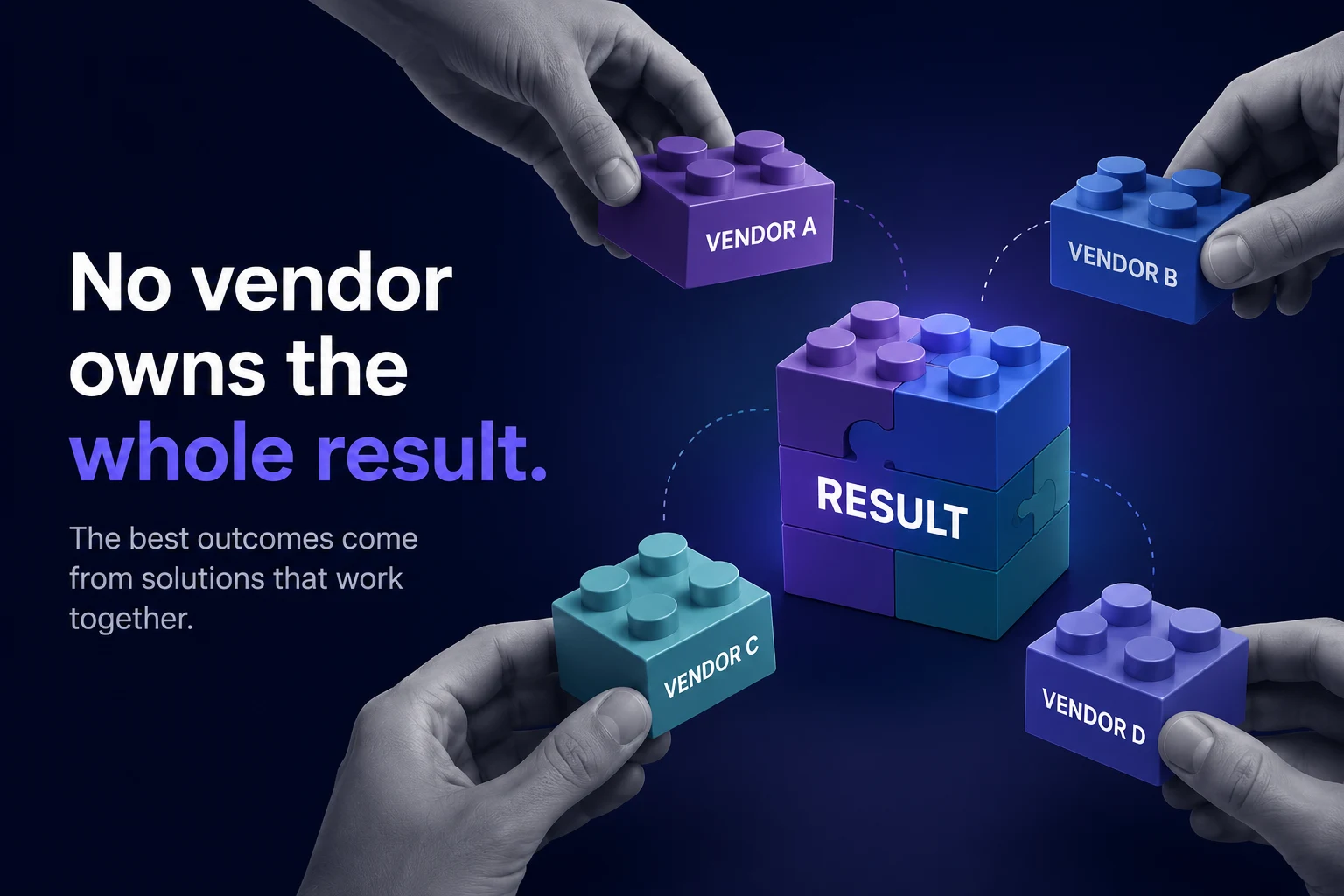
A vendor can do exactly what they were hired to do.
The ticket can be answered. The configuration can be correct. The quote can be fair. The product can work.
And the business result can still be stuck.
That is one of the most common technology problems inside operating companies. It does not look like a system outage. It looks like a gap between products, people, contracts, reporting, training, and decisions.
The failure is not always inside a vendor relationship. It is often between the vendor relationships.
The Vendor Did Their Part
Most vendors are built to answer for their product.
That is reasonable. A software vendor owns the application. A network provider owns the circuit. A security partner owns the tool or service they manage. A consultant owns the scope they were hired to deliver.
But the business does not experience technology as separate vendor scopes.
The business experiences the full path: the request, the approval, the setup, the handoff, the data, the training, the exception, the report, the support path, and the daily habit that follows.
When that path crosses more than one team or product, no single vendor naturally owns the whole result.
That is where the drift starts.
The Gap Becomes the Operating Model
At first, the gap is small.
Someone exports a spreadsheet. Someone keeps a side list. Someone knows which vendor to call. Someone remembers the workaround. Someone manually reconciles the report before leadership sees it.
Those moves are not failures. They are how good teams keep the business running.
But if no one owns the gap, the workaround becomes normal.
- Vendors point to their own scope and miss the operating result.
- Managers chase updates instead of managing the change.
- Reports disagree because the source of truth was never named.
- Staff learn the workaround instead of the intended process.
- Leaders hear different versions of the same problem.
- Projects appear active, but the business keeps operating around them.
The organization slowly builds its real process out of exceptions.
Someone Has to Own the Whole Path
Vendor coordination is not just scheduling meetings or forwarding emails.
It is translating product answers into operating decisions.
That means asking different questions:
- What outcome is the business trying to create?
- Which vendors, systems, and teams touch that outcome?
- Where does one responsibility end and the next one begin?
- What handoff is currently assumed but not owned?
- Which data source wins when reports conflict?
- Who decides when scope, cost, timing, or risk changes?
- How will the result be used in the weekly rhythm of the business?
Without that layer of ownership, every vendor can be right and the operation can still be wrong.
The First Move: Name the Handoffs
When vendor work is stuck, do not start by asking who is at fault.
Start by mapping the handoffs.
Map
Name every vendor, system, team, and decision that touches the result.
Separate
Separate product scope from the operating outcome the business actually needs.
Own
Assign the decision owner, delivery owner, vendor owner, and adoption owner.
Check
Define how the business will know the result is working after the vendor work is done.
This creates a practical operating picture. It shows what each vendor owns, what the business owns, and what no one has been carrying.
The Best Vendor Relationships Need a Strong Operator
Good vendors are valuable. They bring product knowledge, implementation discipline, support teams, and specialized experience.
But even a strong vendor relationship needs an operator on the business side who can connect the work to the real environment.
That operator has to understand the business result, the people who will use the system, the constraints around the rollout, and the decisions leadership will need to make when the clean plan meets a messy day.
That role is not about blaming vendors. It is about making the full result visible enough to manage.
The question is not, ?Which vendor owns this?? The better question is, ?Who owns the result across the vendors??
Where ClingCentral Fits
ClingCentral is built for the work between tools, vendors, decisions, and daily use.
That can mean cleaning up vendor scope, translating technical answers into executive choices, naming decision rights, rebuilding reporting trust, sequencing a rollout, or staying close after launch until the new process holds.
The value is not another product in the stack.
The value is one clear owner for the path the business actually has to run.
A Practical Question for Operators
Where are vendors each answering their part while the full result is still drifting?
Find that spot and name the handoffs.
Name the decision owner. Name the delivery owner. Name the vendor owner. Name the adoption owner. Then name the outcome no vendor owns alone.
That is usually where the real work starts.