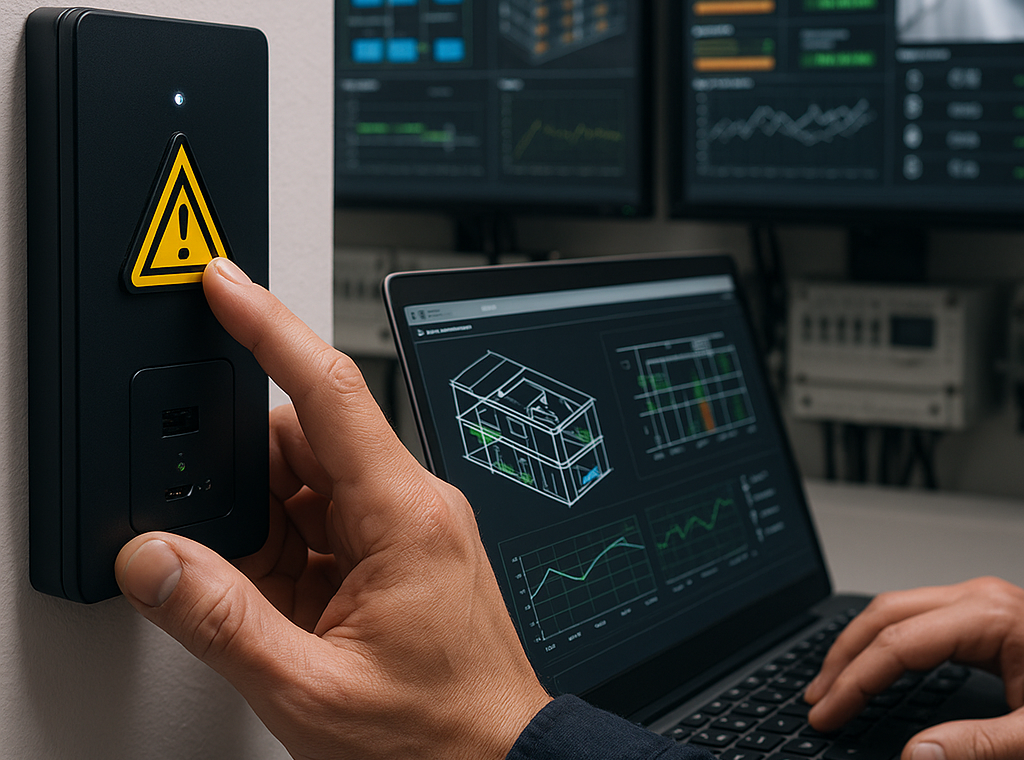
Vulnerabilities in ABB’s EIBPORT systems are not only a device security issue. They expose a larger operational question: who actually owns the control plane of the building? EIBPORT sits in the space where facilities automation, IP networking, vendor support, and business continuity meet. When that layer is weak, the risk is not limited to unauthorized access. The risk is that essential physical operations depend on systems many executives do not govern as critical infrastructure.
The Hidden Issue Behind This Story
The obvious reading is that a building automation product has vulnerabilities and should be patched, segmented, or monitored. That is true, but incomplete.
The more important issue is that systems like ABB’s EIBPORT often occupy a neglected operational category. They are too technical to be managed purely by facilities, too physical to be treated like standard IT, and too embedded to receive the same governance attention as enterprise applications. They control or mediate access to building functions, yet they may sit outside the strongest parts of the security program.
EIBPORT systems are associated with building automation environments, including KNX/EIB-based installations. These systems can provide visualization, control, automation, and integration functions for building infrastructure. That makes them operationally significant even when they appear small, appliance-like, or peripheral.
The hidden issue is not the existence of vulnerabilities. Every technology has vulnerabilities. The hidden issue is the concentration of operational authority inside devices that are often purchased as facilities equipment but connected like IT infrastructure.
A building automation gateway is not just another box on the network. It can become the administrative interface for the physical workplace.
That is the operational lesson. The device may be modest. The authority it holds may not be.
Most coverage of product vulnerabilities focuses on technical exposure: authentication flaws, remote access, patch availability, or configuration weaknesses. Leaders need to look one layer deeper. If a vulnerable component can influence lighting, HVAC, access-related workflows, alarms, energy usage, room scheduling, or facility status data, then the business impact is not measured only in compromised systems. It is measured in disrupted operations, unreliable environments, and recovery complexity.
The gut punch is this: many organizations have better governance over a SaaS expense approval workflow than over the systems that keep their buildings usable.
Why This Matters Operationally
Operators should care because building automation failures do not always look like cybersecurity incidents. They can look like comfort complaints, access delays, energy anomalies, room outages, unexplained equipment behavior, or repeated calls to a facilities vendor. That makes detection slower and accountability less clear.
If leadership ignores this class of exposure, the first failure may not be a dramatic outage. It may be operational ambiguity. IT sees network traffic. Facilities sees equipment behavior. Security sees an advisory. The vendor sees a support ticket. Nobody sees the full system.
That ambiguity matters during an incident. Business continuity depends on fast decisions: isolate, patch, fail over, revert, or operate manually. But building automation environments are often designed for convenience and efficiency, not rapid forensic clarity. When a gateway connects multiple subsystems, the organization may not know whether it can take the device offline without affecting critical functions.
This creates a second-order consequence: the vulnerable device becomes hard to remediate precisely because it is operationally useful. Leaders may delay patching or isolation because the impact is uncertain. That delay increases exposure. The problem is not lack of concern. The problem is lack of dependency knowledge.
Most organizations do not delay remediation because they accept the risk. They delay because they cannot predict the blast radius.
In a modern building, the physical environment is part of the technology stack. Office occupancy, data center cooling, lab conditions, physical security workflows, manufacturing-adjacent environments, retail operations, and energy management can all depend on automation systems. A vulnerable building control component can therefore affect employee availability, customer-facing operations, regulatory conditions, safety procedures, and cost controls.
This is especially relevant where infrastructure is lean. Smaller teams often depend heavily on vendor-managed configurations, remote support, and long-lived embedded devices. The budget may have funded installation but not lifecycle governance. That is a common pattern in operational technology: capital expense receives attention; ongoing operational control receives less.
The risk is not that every EIBPORT deployment is business-critical. The risk is that many organizations do not know which ones are.
The Dependency Most Organizations Overlook
The overlooked dependency is not simply the device. It is the chain of authority around the device.
Building automation systems depend on vendors, installers, network access, firmware availability, configuration backups, remote support practices, credentials, documentation, physical access, and internal ownership. If any one of those is weak, remediation becomes slower. If several are weak, the device becomes an unmanaged control point.
In many environments, the organization depends on a vendor or integrator that understands the building logic better than internal teams do. That is not inherently wrong. Specialized systems require specialized expertise. The problem begins when vendor knowledge becomes the only operational map.
If the vendor knows which automation scenes exist, which schedules are active, which IP addresses matter, which credentials are shared, and which dependencies break during reboot, then the organization does not fully own its own operating environment. It rents operational certainty from the vendor.
Vendor dependency is not only contractual. It is architectural when the vendor is the only party that understands how the system behaves.
This challenges a common assumption: that asset ownership equals operational control. An organization may own the building, the controllers, the network, and the licenses. But if it cannot independently answer what happens when a gateway is patched, isolated, restored, or replaced, then ownership is incomplete.
Another hidden dependency is data trust. Building automation systems increasingly feed dashboards, energy analytics, occupancy models, service workflows, and sometimes AI-assisted operations. If the control or data layer is vulnerable, downstream automation may act on compromised or unreliable inputs. This is not an abstract AI governance issue. It is a basic operational principle: automated decisions are only as trustworthy as the systems producing the signals.
For example, if occupancy, temperature, equipment status, or access-related signals are consumed by other systems, then a compromised or unstable building automation gateway can create bad operational decisions elsewhere. Energy systems may optimize incorrectly. Service teams may chase false conditions. Security teams may misinterpret activity. Capacity planning may rely on distorted data.
The non-obvious lesson is that building automation vulnerabilities can corrupt both action and perception. They can affect what systems do and what leaders believe is happening.
That is why the dependency matters. The gateway is not only a control interface. It may also be a source of operational truth.
What This Changes For Leadership
Executives should reconsider how building automation is governed. The decision is not whether every facilities device belongs under central IT. That framing creates resistance and misses the point. The better question is which systems have operational authority and therefore require executive-level governance.
If a device can affect building availability, physical operating conditions, security workflows, or business continuity, it should not be managed as a passive facilities asset. It should have lifecycle ownership, risk classification, segmentation standards, patch decision rules, backup expectations, and incident procedures.
This changes investment priorities. Many organizations spend heavily on endpoint detection, cloud controls, identity systems, and application security while leaving building automation in a lower maturity tier. That may have made sense when facilities systems were isolated, analog, or locally administered. It makes less sense when those systems are IP-connected, remotely supported, and integrated with business workflows.
The executive decision to reconsider is the boundary between IT, security, and facilities budgets. If each function funds only its own visible priorities, shared infrastructure falls through the gaps. Building automation is often one of those gaps.
Leadership should also reconsider vendor risk assessments. A standard vendor questionnaire may not capture operational reality. The key issue is not only whether the vendor has security policies. It is whether the organization can operate safely if the vendor is unavailable, slow to respond, or unable to support a vulnerable legacy deployment.
That means procurement decisions need to account for maintainability, documentation, upgrade paths, configuration export, support models, remote access controls, and end-of-life transparency. A cheaper installation can become expensive if every future security action requires custom vendor intervention.
There is also an incentive problem. Facilities teams are often measured on uptime, comfort, cost, and responsiveness. Security teams are measured on exposure reduction. IT teams are measured on reliability and service delivery. These incentives can collide. A patch that reduces security exposure may be perceived as a threat to building stability. A segmentation change that improves control may break vendor support. A vendor remote access path that accelerates maintenance may increase attack surface.
Leadership has to resolve those tradeoffs before an incident. During an incident, the default incentive is to preserve current operations, even if that preserves exposure.
What Operators Should Evaluate Now
Map control authority, not just assets
An asset inventory is useful, but it is not enough. Operators need to understand what each building automation component can influence. Does the system only visualize status, or can it change schedules, trigger scenes, modify setpoints, bridge networks, or administer other devices?
This matters because remediation priority should follow operational authority. A lightly used display panel and a gateway with broad control authority do not carry the same risk. Treating them as equal assets leads to poor sequencing.
The problem this prevents is blind isolation. If a vulnerability requires urgent action, teams need to know what breaks when the device is disconnected or restricted.
The assumption it challenges is that all devices in a building automation network are operationally equivalent. They are not. Some are endpoints. Some are control planes.
Define who can approve operational risk decisions
When a vulnerable building automation system cannot be patched immediately, somebody is accepting risk. That decision should not be buried inside a facilities ticket or left to the vendor by default.
This matters because risk acceptance without authority creates accountability gaps. If leadership later discovers that a critical control system remained exposed for months, the question will not be only technical. It will be governance-related.
The problem this prevents is informal exception management. Operational teams often make practical compromises to keep systems running. Those compromises need visibility when they affect business continuity or security exposure.
The assumption it challenges is that technical teams can absorb cross-functional risk without executive involvement. They cannot. They can describe options. Leadership must own the tradeoff.
Test degraded building operations
Operators should know how the building behaves when the automation gateway is unavailable, isolated, restored from backup, or operating with limited connectivity. This should not be discovered during a vulnerability response.
This matters because resilience is not proven by uptime. It is proven by controlled failure. A system that has never been tested in degraded mode may be more fragile than its availability history suggests.
The problem this prevents is remediation paralysis. If teams know manual procedures, fallback modes, and restoration steps, they can act faster when exposure requires action.
The assumption it challenges is that automation improves resilience by default. Automation improves consistency under normal conditions. It can reduce resilience if nobody can operate without it.
Review vendor remote access as an operational dependency
Building automation vendors often need access for support, troubleshooting, or updates. The question is not whether remote support is convenient. The question is whether it is controlled, logged, time-bound, and removable without disrupting operations.
This matters because vendor access can become the hidden path into a sensitive operational environment. It also becomes a dependency during incident response if the organization cannot make changes without the vendor.
The problem this prevents is a support model that quietly overrides security architecture. Remote access created for maintenance can become permanent infrastructure.
The assumption it challenges is that vendor-managed access is automatically safer because the vendor understands the system. Expertise does not eliminate access risk.
Treat configuration backups as business continuity assets
Firmware can often be replaced. Configuration knowledge is harder to reconstruct. Building automation systems may contain schedules, scenes, device mappings, integration logic, and site-specific settings that determine how the environment actually operates.
This matters because recovery depends on more than reinstalling software. Without validated backups and restoration procedures, a security event can become a prolonged operational outage.
The problem this prevents is vendor-dependent recovery. If the only reliable configuration record lives with an installer, a contractor, or an aging device, recovery time becomes uncertain.
The assumption it challenges is that backup strategy is primarily an IT server issue. In automated buildings, configuration is operational memory.
Validate downstream data use
If EIBPORT or related building automation systems feed dashboards, analytics, service workflows, or AI-assisted tools, operators should identify where that data goes and what decisions depend on it.
This matters because compromised or unreliable building data can create bad decisions outside the facilities domain. Automation can amplify false inputs faster than people can challenge them.
The problem this prevents is silent propagation. A bad signal from a building system can move through reporting, optimization, alerting, and workflow tools without anyone recognizing the original source.
The assumption it challenges is that facilities data is low consequence. Once data drives automation, it becomes part of the decision system.
What to Watch
Several developments will matter more than the vulnerability details themselves.
First, watch how vendors handle lifecycle transparency. For building automation products, security advisories are only useful if customers can determine affected versions, operational impact, upgrade paths, compensating controls, and support status. A technically correct advisory is not enough if operators cannot translate it into safe action.
Second, watch for integration creep. Building systems are increasingly connected to energy management platforms, workplace experience tools, occupancy analytics, remote support portals, mobile apps, and automation layers. Each integration may be justified individually. Collectively, they expand the control and data surface.
Third, watch for aging infrastructure. Building automation devices often remain in service longer than standard IT assets. Long lifecycles are normal in facilities environments, but they create tension with cybersecurity expectations. A system designed for a decade of physical service may not have a decade of secure software support.
Fourth, watch incident response assumptions. Many organizations have playbooks for ransomware, identity compromise, cloud outages, and endpoint containment. Fewer have tested playbooks for building automation compromise. The response requires different participants, different safety considerations, and different recovery criteria.
Fifth, watch the role of AI and analytics in facilities operations. AI does not need direct control of building systems to introduce risk. If it consumes building data, recommends actions, opens tickets, adjusts schedules, or influences energy decisions, then the trustworthiness of the underlying automation environment becomes an AI governance concern.
Certainty remains low in one important area: the actual business impact of any specific vulnerability depends on deployment architecture. A well-segmented, locally controlled, documented environment has a different risk profile than an internet-exposed, vendor-dependent, poorly documented one. The same product vulnerability can produce very different operational consequences.
That is why leaders should avoid both complacency and overreaction. The right response is not panic. It is dependency clarity.
Vulnerabilities in ABB’s EIBPORT systems are a reminder that operational control often lives in places leadership rarely reviews. The lesson is broader than one product or advisory. Connected buildings are now part of the enterprise technology estate, even when they are funded, installed, and supported through facilities channels. The strategic takeaway is simple: if a system can affect business operations, it deserves governance before it becomes an incident.