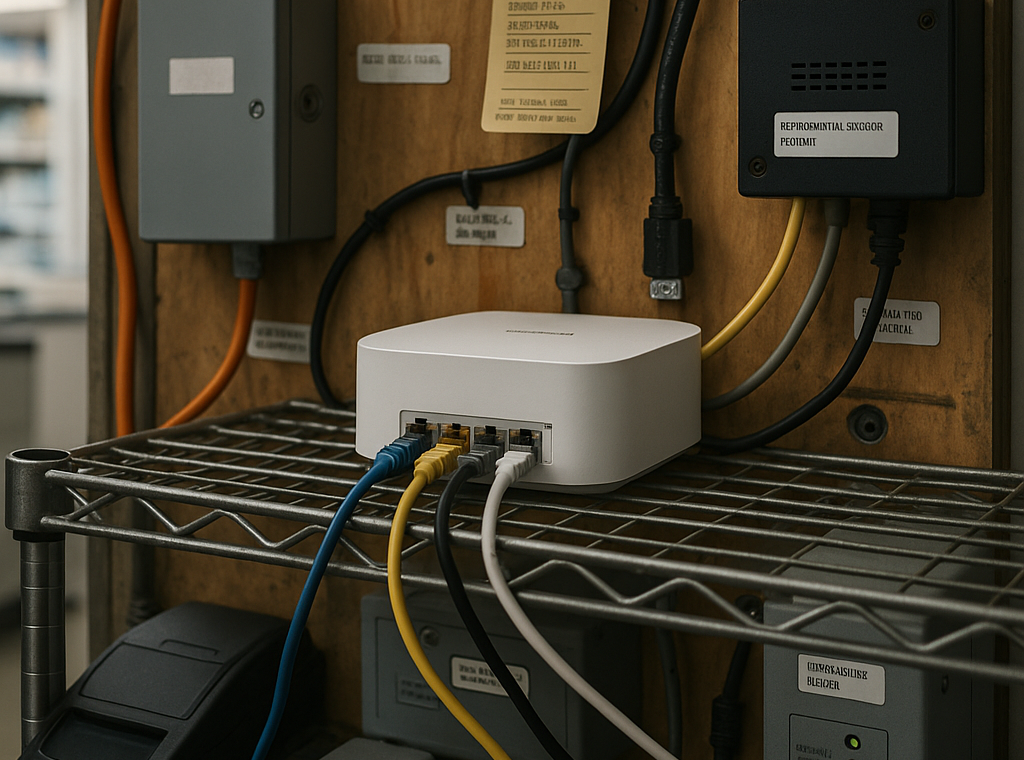
A maximum-severity zero-day in a mesh router is not just a device security problem. It is a reminder that many organizations have moved critical access, monitoring, automation, and remote-work continuity onto infrastructure they do not fully govern. The important question is not whether one vendor patches one product. The question is whether leadership knows which operational decisions depend on unmanaged edge equipment behaving safely.
The Hidden Issue Behind This Story
The reported issue involves Acer working to address two maximum-severity zero-day vulnerabilities affecting its Wave 7 mesh routers. The available public detail is limited, so the durable lesson should not be built around assumptions about exploit mechanics, affected deployments, or attacker behavior.
The operational lesson is larger: edge network devices are often treated as low-level plumbing, but they increasingly function as business control points. They decide what connects, what routes, what stays online, what can be observed, and what becomes unreachable during disruption.
The router is no longer just network equipment. In many environments, it is the local authority boundary for the business.
That reframes the issue. A zero-day in a router is not only a path into a network. It can become a failure in remote access, customer service, inventory operations, payment processing, building systems, telemetry, AI data ingestion, and incident response visibility. The device may be small. The dependency is not.
Most coverage of zero-days focuses on exploitation and patching. Operators know the harder problem is control. Who owns the device? Who knows it exists? Who can patch it? Who can isolate it? Who has budget authority? Who accepts downtime? Who is accountable if the device sits between the business and its ability to operate?
That is the hidden issue: the vulnerability exposes a governance boundary that often was never formally designed.
Why This Matters Operationally
Operational risk is rarely created by a single vulnerability. It is created when a vulnerability lands inside an environment where ownership, visibility, and response authority are unclear.
Mesh routers and similar edge devices often appear in places that do not fit neatly into enterprise infrastructure models: small offices, temporary sites, executive homes, retail locations, warehouses, clinics, labs, acquired businesses, vendor-managed spaces, and operational technology environments. Some are procured through IT. Some are bought locally. Some are installed by service providers. Some are inherited during expansion. Some are treated as consumer-grade conveniences even after becoming business-critical.
That creates a practical problem during a zero-day event. Security may identify exposure, but operations may depend on the device. IT may want to replace it, but the location may have no local technical staff. Procurement may own the vendor relationship, but not the risk. A business unit may rely on connectivity but not understand the infrastructure. The service provider may manage the circuit but not the LAN. Nobody is malicious. The system is just designed to diffuse accountability.
The first-order risk is compromise. The second-order consequence is operational paralysis: teams cannot act quickly because the authority map is unclear.
This matters because incident response is not only a technical capability. It is an organizational capability. A security team that cannot identify device ownership, business dependency, replacement options, or maintenance windows is not controlling risk. It is negotiating with uncertainty during an active event.
Most organizations do not discover their edge architecture. They inherit it.
That inheritance becomes expensive when a maximum-severity vulnerability appears. Every unknown device becomes a question. Every remote site becomes a dependency investigation. Every exception becomes a potential business continuity problem.
The Dependency Most Organizations Overlook
The overlooked dependency is not the router itself. It is the assumption that connectivity at the edge is available, trustworthy, and operationally boring.
Many modern processes depend on that assumption. Cloud applications assume stable access. Endpoint management assumes agents can reach control services. Identity systems assume users can authenticate. Backup tools assume data can move. Monitoring platforms assume telemetry arrives. AI and automation workflows assume source systems remain connected and data flows are valid. Security tools assume they can see enough to detect abnormal behavior.
When the edge device is vulnerable, unavailable, or untrusted, those assumptions break together.
This is where the issue becomes more than cybersecurity. If a router can no longer be trusted, the organization may need to question the integrity of logs, device connections, traffic paths, configuration changes, and local access decisions. If it must be taken offline, the organization may lose operational visibility at the same moment it needs visibility most.
The hidden dependency is trust in the local network control plane. Many leaders assume the control plane lives in the data center, the cloud platform, or the identity provider. At the edge, however, the router often decides the immediate facts on the ground: what is reachable, what is segmented, what can fail over, what can be inspected, and what is exposed.
Gut punch: if a site’s router is compromised, your cloud-first strategy may still be dependent on a locally unmanaged box nobody budgeted as critical infrastructure.
That should change how leadership views “small” infrastructure. A device can be inexpensive and still carry high operational leverage. Cost is not a reliable proxy for business impact.
There is also an incentive conflict. Business units want fast connectivity. Vendors want simple deployment. Procurement wants lower unit cost. Security wants manageability. Operations wants standardization. Finance wants fewer recurring expenses. The result is often a compromise device installed at a critical point without the controls normally required for critical infrastructure.
That is not a technology failure. It is an incentive design problem.
What This Changes For Leadership
The executive decision that should be reconsidered is whether edge networking can continue to be treated as a procurement category instead of an operational risk domain.
Routers, wireless systems, firewalls, remote access gateways, and managed connectivity devices are not interchangeable commodities once they support business operations. They differ in patch support, logging, remote management, segmentation, vendor response, configuration control, lifecycle transparency, and replacement options. Those differences determine whether an organization can respond in hours or spend days finding out what it owns.
Leadership should also reconsider where accountability sits. If security is accountable for risk but cannot enforce device standards, replace equipment, or approve downtime, then accountability is symbolic. If infrastructure owns the devices but has no inventory of business processes using them, control is incomplete. If business units can deploy local connectivity without accepting operational obligations, risk is being subsidized by the enterprise.
Ownership without operational authority is not control.
This has budget implications. Resilience is often funded after failure because the cost of prevention looks optional when everything is working. Edge standardization, asset discovery, vendor rationalization, spare equipment, and remote management may appear inefficient until a zero-day turns every unknown site into a manual investigation.
The leadership question is not “Are we patched?” It is “Can we make a reliable decision under pressure across every place the business depends on connectivity?”
That question reaches into governance. Organizations need clear rules for who may introduce edge infrastructure, what minimum manageability is required, how exceptions are approved, how vendor support is evaluated, and how business criticality changes technical standards. Without that, every emergency becomes a debate about authority.
What Operators Should Evaluate Now
Map edge devices to business processes, not just networks
Asset inventories often list devices by IP address, model, serial number, or site. That is useful, but insufficient. Operators need to know what business process fails if the device is isolated, patched, replaced, or misconfigured.
This matters because a vulnerability response is constrained by business impact. It prevents the common problem of treating every device as technically equal while discovering too late that one supports payment processing, physical access, dispatch, manufacturing telemetry, or executive communications. It challenges the assumption that network topology alone describes operational importance.
Identify who has authority to act before an incident
For each class of edge infrastructure, determine who can approve emergency changes, who can take a site offline, who can contact the vendor, who can replace equipment, and who owns the business impact of downtime.
This matters because speed during a zero-day depends on pre-existing authority. It prevents response teams from losing critical time to escalation chains and political negotiation. It challenges the assumption that technical ownership automatically includes operational decision rights.
Evaluate vendor dependency as an operational dependency
Vendor risk should include more than financial stability and contractual language. Operators should understand how quickly firmware is delivered, how updates are distributed, whether devices can be centrally managed, whether logging is adequate, whether configurations can be backed up, and whether replacement paths exist.
This matters because a vendor’s response model becomes part of the organization’s response model. It prevents leadership from assuming that a patch announcement equals operational remediation. It challenges the assumption that purchasing a supported product transfers the burden of resilience to the vendor.
Separate “internet access” from “trusted access”
If an edge device becomes suspect, the organization may still need a way to keep the business running without treating that path as trusted. That may require alternative connectivity, stricter identity controls, conditional access, segmented recovery paths, or temporary operational procedures.
This matters because continuity plans often assume the network is either up or down. A zero-day creates a third state: connected but untrusted. It prevents a false choice between full shutdown and full exposure. It challenges the assumption that availability and trustworthiness are the same condition.
Review exceptions that became permanent architecture
Temporary routers, locally purchased mesh systems, vendor-installed connectivity, and emergency remote-work setups often persist long after the original need passes. Operators should identify which exceptions now support routine operations.
This matters because exceptions accumulate into architecture without passing through architecture review. It prevents hidden control planes from forming outside enterprise standards. It challenges the assumption that temporary decisions expire on their own.
What to Watch
The immediate facts around any specific zero-day will evolve as vendors, researchers, and affected customers publish more detail. Certainty may remain low at first. Operators should avoid building plans around unverified claims, but they should not wait for perfect information to examine exposure, ownership, and response readiness.
Watch for signals that change operational priority: evidence of active exploitation, public proof-of-concept code, delayed or manual patch processes, unclear affected versions, weak logging, or difficulty confirming device state remotely. Each signal affects not only technical risk but response cost.
Also watch how the organization reacts internally. If teams cannot quickly answer where affected devices are, who owns them, whether they are internet-facing, what business functions depend on them, and how they can be updated or replaced, that is the finding. The vulnerability has exposed an operating model gap.
Emerging risk will also come from increasing dependence on distributed infrastructure. Branch offices, home offices, pop-up operations, IoT environments, AI-enabled monitoring, and automated workflows all expand the importance of edge connectivity. The more automation depends on data movement, the more the network edge becomes part of the automation control surface.
That matters for AI governance as well. AI systems that consume operational data inherit the trust assumptions of the infrastructure carrying that data. If edge devices are unmanaged or untrusted, the issue is not only whether systems are available. It is whether downstream decisions are being made from reliable inputs.
The areas of uncertainty are practical: how many devices exist outside formal inventory, how many are business-critical, how many can be patched remotely, and how many require physical intervention. Those questions are less exciting than exploit details, but they determine the real cost of response.
Zero-days are usually discussed as security events. Operators should treat them as audits of control. The lasting lesson is that small edge devices can carry large business authority when they sit between operations and the systems operations depend on. Leadership does not need to predict every vulnerability. It does need to know which dependencies are too important to remain informal.